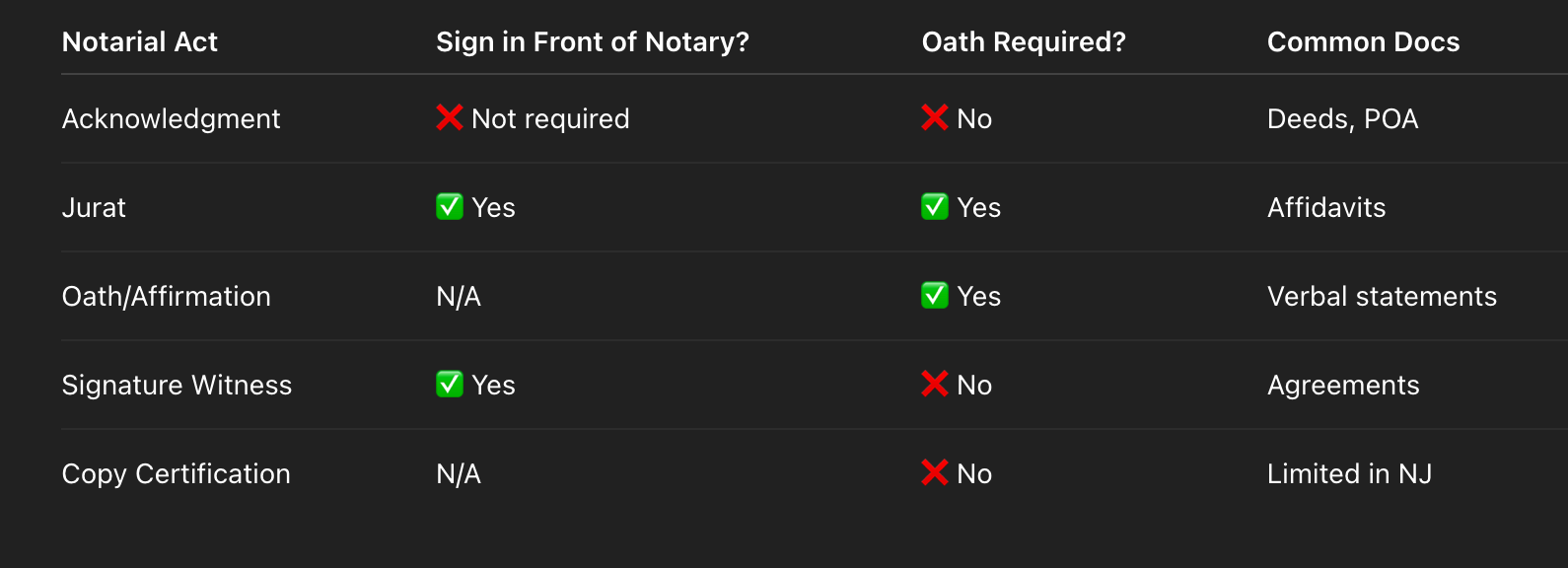
Common Notarial Acts Explained
🖊️ Acknowledgment
Confirms that you signed a document willingly. The document may be signed before or in the presence of the notary.
📄 Jurat
Requires you to sign in front of the notary and swear or affirm that the contents of the document are true.
⚖️ Oath / Affirmation
A formal declaration that statements are truthful, commonly used for affidavits and sworn statements.
✔️ Verification on Oath
The signer confirms under oath that the contents of a document are true, typically required for legal filings.
👁️ Signature Witnessing
The notary witnesses the signing and verifies the identity of the signer at the time of execution.
📑 Copy Certification
Certifies that a copy is a true and accurate reproduction of the original, where permitted by law.
👥 Proof of Execution
A witness confirms to the notary that they observed the original signer execute the document.
📘 Attestation
The notary certifies that a notarial act has been properly completed.
What Happens During a Signing
1. Identity Verification
A valid, government-issued ID is reviewed to confirm your identity.
2. Document Review
The notary ensures the document is complete and ready for notarization.
3. Signing
You sign the document (in person or online) in accordance with the required notarial act.
4. Notarial Seal
The notary completes the certificate and applies their official seal.
💡 Did You Know? Power of Attorney Signatures Are Different
When signing as a Power of Attorney (POA), you are signing on behalf of another person—not yourself. This means your signature must clearly show that you are acting as an authorized representative.
Signing incorrectly can result in rejected documents, delays, or legal issues. We help guide you through the correct format during your appointment.
Correct Example:
John Smith, by Jane Smith, his Attorney-in-Fact
Common Mistake:
Jane Smith
(This does not show that you are signing on behalf of someone else.)
Not sure how to sign? Don’t worry—Hudson Notary Service will guide you to ensure your documents are completed correctly.
Ready to Schedule Your Appointment?
Experience a smooth, professional notarization with expert guidance every step of the way.